The research activities developed within Professor Eddaoudi's group mainly aimed at designing new functional solid-state materials for targeting specific applications, namely, gas storage-separation, catalysis, chemical sensing. Accordingly, Prof. Eddaoudi has settled different powerful strategies to design made-to-order Metal Organic Framework (MOF) materials to address some of challenging and enduring societal issues.
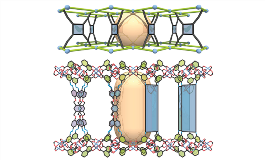
Our group has recently introduced a novel building approach, the supermolecular building layer (SBL) approach, where readily targeted 2D MOF layers (SBLs) based on edge transitive nets [e.g., sql, hxl, hcb, kgm, kgd] and judiciously selected pillars (i.e., organic ligands)} are utilized to construct targeted, functional 3D porous MOFs. A myriad of MOFs having specific underlying network topology can be designed and synthesized utilizing the pre-targeted SBLs, where the overall framework remains constant while expansion of the confined space (e.g., porosity) is simple and functionalities can readily be introduced to target specific desirable applications.
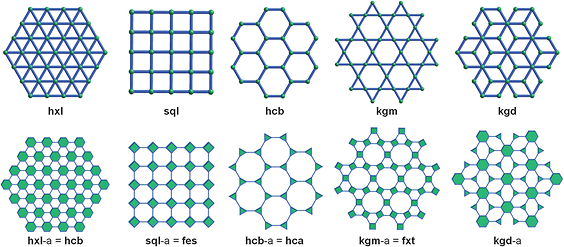
The supermolecular building layer (SBL) approach was employed to deliberately synthesize two MOF platforms, eea-MOF and rtl-MOF, based on pillaring of kgm-a or sql-a layers with heterofunctional 3-connected organic building blocks.
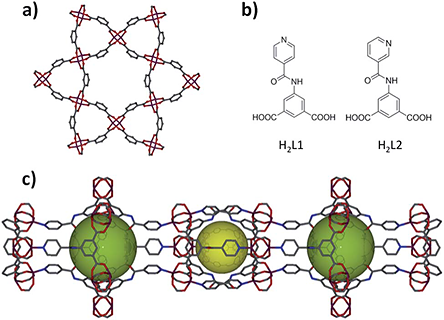
(a) Layer segment of a kgm-MOF. (b) Left: 5-(isonicotinamido) isophthalic acid (H2L1) and right: 5-(nicotinamido)isophthalic acid (H2L2). (c) Hourglass-shaped channels with two primary types of cavities. C ¼ gray, O ¼ red, N ¼ blue, Cu ¼ plum; H atoms are omitted for clarity.